Corporate Bonds vs Dividend Stocks: Which Yields More?

Corporate Bonds vs Dividend Stocks: Which Yields More When Investing in the Same Company?
Investing in the same enterprise through debt instruments or common stock creates fundamentally different cash flows and risk profiles when comparing bond interest and dividends. Recent market data demonstrates that while certain companies offer fixed bond coupon rates that substantially exceed their dividend yield, other corporations deliver equity dividend yields that outperform bond coupons by a wide margin. A rigorous statistical examination enables investors to align their portfolio asset allocation between fixed income vs equity dividends effectively.
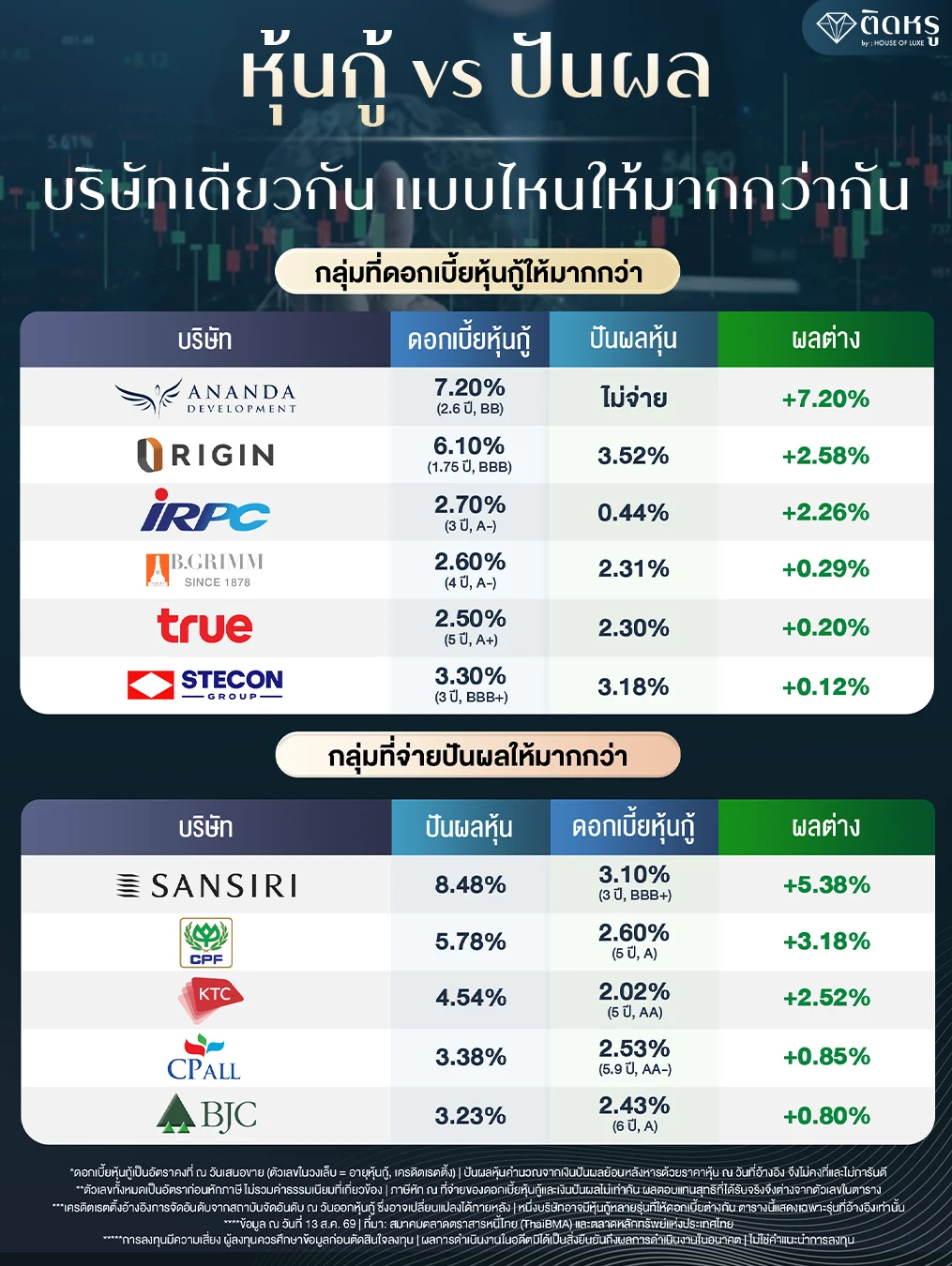
Comparative Statistics Across 11 Leading Corporations: Bond Yields vs Stock Dividends
An analytical breakdown comparing corporate debentures against equity dividend yields across 11 listed enterprises reveals two distinct yield structures
1. Companies Where Corporate Bond Yields Outperform Dividend Yields
-
ANAN (Ananda Development): Bond Coupon 7.20% (Tenor 2.6 Years, Credit Rating BB) | Dividend Yield 0.00% (No Payout) | Spread: +7.20%
-
ORI (Origin Property): Bond Coupon 6.10% (Tenor 1.75 Years, Credit Rating BBB) | Dividend Yield 3.52% | Spread: +2.58%
-
IRPC: Bond Coupon 2.70% (Tenor 3 Years, Credit Rating A-) | Dividend Yield 0.44% | Spread: +2.26%
-
BGRIM (B.Grimm Power): Bond Coupon 2.60% (Tenor 4 Years, Credit Rating A-) | Dividend Yield 2.31% | Spread: +0.29%
-
TRUE (True Corporation): Bond Coupon 2.50% (Tenor 5 Years, Credit Rating A+) | Dividend Yield 2.30% | Spread: +0.20%
-
STECON (Stecon Group): Bond Coupon 3.30% (Tenor 3 Years, Credit Rating BBB+) | Dividend Yield 3.18% | Spread: +0.12%
2. Companies Where Dividend Yields Outperform Corporate Bond Yields
-
SIRI (Sansiri): Dividend Yield 8.48% | Bond Coupon 3.10% (Tenor 3 Years, Credit Rating BBB+) | Spread: +5.38%
-
CPF (Charoen Pokphand Foods): Dividend Yield 5.78% | Bond Coupon 2.60% (Tenor 5 Years, Credit Rating A) | Spread: +3.18%
-
KTC (Krungthai Card): Dividend Yield 4.54% | Bond Coupon 2.02% (Tenor 5 Years, Credit Rating AA) | Spread: +2.52%
-
CPALL (CP ALL): Dividend Yield 3.38% | Bond Coupon 2.53% (Tenor 5.9 Years, Credit Rating AA-) | Spread: +0.85%
-
BJC (Berli Jucker): Dividend Yield 3.23% | Bond Coupon 2.43% (Tenor 6 Years, Credit Rating A) | Spread: +0.80%
Critical Risk Factors to Evaluate When Comparing Corporate Bonds vs Dividend Stocks
When deciding whether investing in bonds vs dividend stocks suits your wealth strategy, yield metrics alone should not dictate capital allocation without evaluating structural risks:
-
Credit Rating & Default Risk: Higher coupon yields often compensate for elevated credit risk, as seen with ANAN (BB rating), whereas high investment-grade issuers like KTC (AA rating) offer lower coupon yields in exchange for balance-sheet safety.
-
Equity Price Volatility (Capital Gains & Losses): Dividend yields fluctuate based on operating performance and underlying share prices; significant capital depreciation can easily erode nominal dividend income, resulting in negative total returns.
-
Withholding Tax Differentials: Fixed-income interest and equity dividends are subject to differing withholding tax treatments and tax credit eligibility, impacting net realized yields.
Strategic Investment Planning: Aligning Fixed Income and Equities with Your Portfolio Goals
-
Market data compiled as of August 13, 2026, sourced from the Thai Bond Market Association (ThaiBMA) and the Stock Exchange of Thailand (SET).
-
Corporate bond coupons represent fixed rates at the time of issuance for the referenced tranches, while dividend yields reflect trailing payout distributions relative to market price. All figures are stated gross before applicable withholding taxes.
-
Disclaimer: Investments carry risk. Investors should thoroughly review the prospectus and company disclosures before making any investment decisions. Historical performance is not indicative of future results.
Recommended for You

Thai Airways Business Class Upgrade Airport Rates & Guide

Free Investing Courses SET Master Stocks, Funds & Global

1M THB Bank Stock Investment: 7-Month Returns Review

💬 Comments
0✍️ Add a Comment